Uncategorized

All news.

United States: Credential As You Go – Building a National Ecosystem for Incremental Credentialing

The United States has a highly decentralised education system, with many states, institutions, and employer networks operating independently. In this context, Credential As You Go (CAYG) was created to support short, stackable, and portable credentials that can be recognised across institutions and state borders. Rather than only valuing full degrees, CAYG promotes incremental credentialing, meaning […]

United States: Credential As You Go – Building a National Ecosystem for Incremental Credentialing Read More »

Designing for Trust: Ireland’s Micro-Credential Framework and Its Design Principles

Ireland is one of the most advanced European countries in micro-credential development. Through the MicroCreds initiative and the work of QQI, it has built a national approach with clear design principles, governance, and digital support. This makes Ireland an important case for sector-specific credential development. The Irish Context Ireland’s focus on micro-credentials comes from the

Designing for Trust: Ireland’s Micro-Credential Framework and Its Design Principles Read More »

Spain’s Approach to Micro-Credentials – The Catalogue of Training Specialties and Automotive Sector Upskilling

Spain has developed a practical approach to short-form credentials through its Catalogue of Training Specialties, managed by SEPE, the national public employment service. Although Spain does not yet have a standalone micro-credential framework, its training system already supports fast, targeted upskilling in areas such as electric and connected vehicles. The Catalogue of Training Specialties Spain

Spain’s Approach to Micro-Credentials – The Catalogue of Training Specialties and Automotive Sector Upskilling Read More »

Building Pathways: How Portugal Structures Automotive Qualifications and Micro-Credentials

Portugal shows how short training programes can be built into a broader national qualifications system. Our research looked at three examples in the automotive sector: a post-secondary course in electric and hybrid vehicle mechatronics, a mandatory certification for vehicle air conditioning technicians, and a short modular pathway in electric and hybrid vehicle technologies. Together, they

Building Pathways: How Portugal Structures Automotive Qualifications and Micro-Credentials Read More »

From Industry Standards to Micro-Credentials: Finland’s Approach to Electrical Safety Training

Finland shows how an existing industry standard can work like a micro-credential. The key example is SFS 6002, the national standard for electrical safety and live work training. Our research examined this system to see what it can offer the automotive sector. What SFS 6002 Does SFS 6002 sets the safety requirements for people working

From Industry Standards to Micro-Credentials: Finland’s Approach to Electrical Safety Training Read More »

Micro-Credentials Across Borders: Lessons from Five National Approaches

As part of the Autocredify project, our research examined existing micro-credential initiatives and related frameworks in five countries: Finland, Portugal, Spain, Ireland, and the United States. The aim was to identify established practices and draw lessons that can inform the development of sectoral micro-credentials for the European automotive industry. Why These Five Cases? Each of

Micro-Credentials Across Borders: Lessons from Five National Approaches Read More »

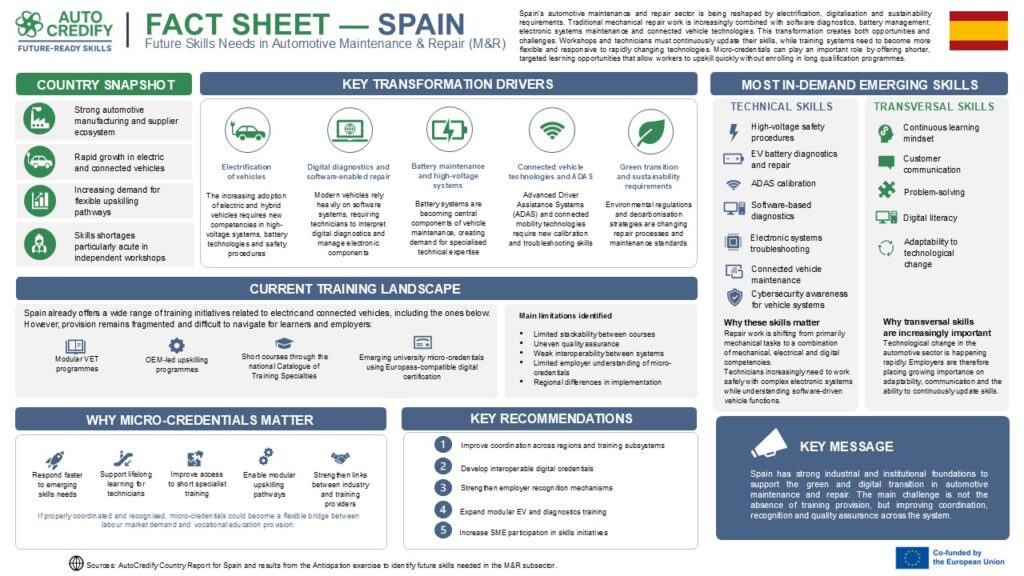
AutoCredify Shares Fact Sheet: Spain

Spain’s automotive maintenance and repair sector is being reshaped by electrification, digitalisation and tightening sustainability requirements. Traditional mechanical repair is increasingly combined with software diagnostics, battery management, electronic systems maintenance and connected vehicle technologies — pushing demand for skills such as high-voltage safety, EV battery diagnostics, ADAS calibration, software-based troubleshooting and even cybersecurity awareness for

AutoCredify Shares Fact Sheet: Spain Read More »

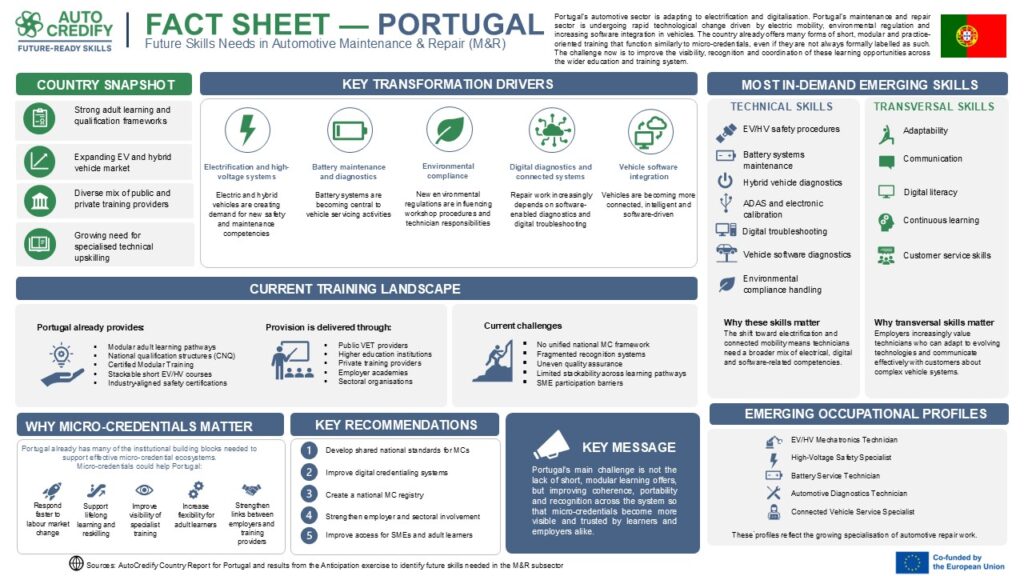
AutoCredify Shares Fact Sheet: Portugal

Portugal’s automotive maintenance and repair sector is undergoing rapid change, driven by electric mobility, environmental regulation and increasing software integration in vehicles. Technicians now need a broader mix of electrical, digital and software-related competencies, with rising demand for skills such as EV/HV safety, battery systems maintenance, ADAS calibration and connected-vehicle diagnostics. As the fact sheet

AutoCredify Shares Fact Sheet: Portugal Read More »

AutoCredify Shares Fact Sheet: Finland

Finland’s automotive maintenance and repair sector is adapting rapidly to the green and digital transition. As vehicles become more connected and technologically advanced — driven by electrification, software-enabled maintenance, ADAS and AI — workshops increasingly need technicians who can combine traditional repair expertise with high-voltage, electrical and software competencies. The fact sheet below maps out

AutoCredify Shares Fact Sheet: Finland Read More »

How to Fund Micro-Credentials That Last

Financial sustainability is the dimension of micro-credential development that receives the least attention in public discourse in private conversations among training providers, VET authorities, and project coordinators. The AutoCredify Good Practice Mapping Report addresses this directly, and its findings are candid: across virtually all of the practices reviewed, systematic information on long-term funding models, unit

How to Fund Micro-Credentials That Last Read More »